

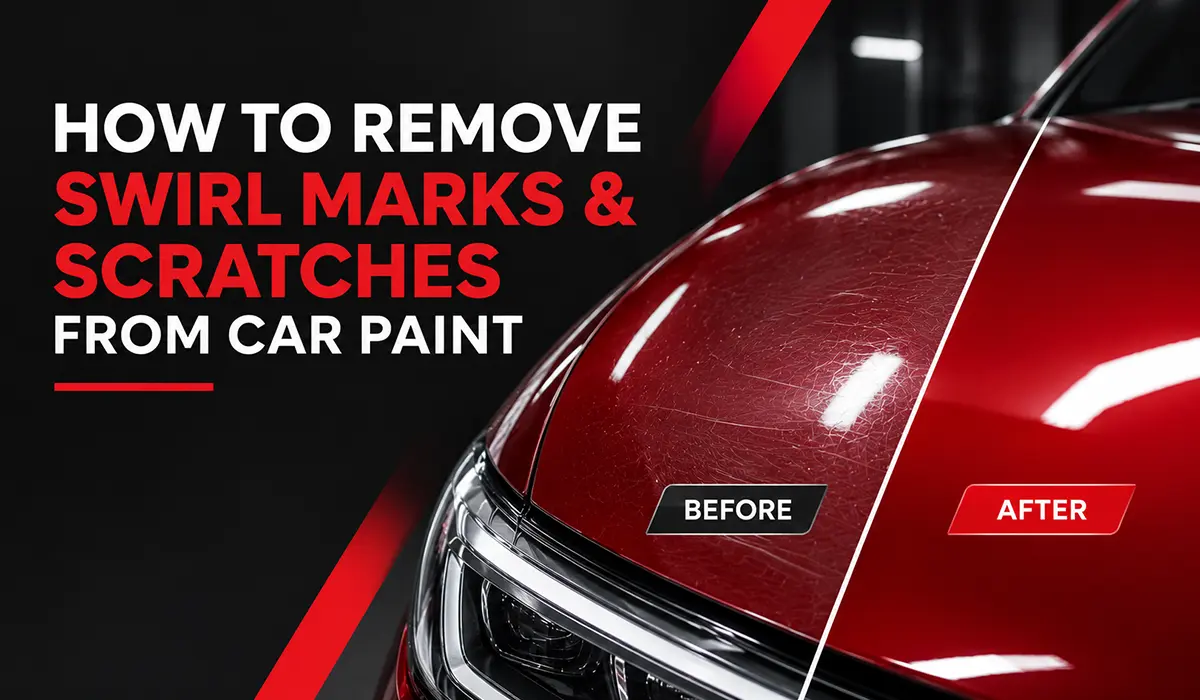
To remove swirl marks and light scratches from car paint, you machine polish the clear coat to level the surface until the marks are gone. This only works on damage that sits inside the clear coat. Hand polishing and bottled “swirl remover” products usually just fill the marks and hide them for a few washes. Deep scratches that cut through to the colour or primer cannot be polished out at all.
You can do this yourself with a dual-action polisher, and the steps are below. But polishing removes real clear coat, and mistakes cannot be undone, so this guide also shows how to judge the damage and when to hand it to a professional.
Swirl Marks and Scratches at a Glance
| Damage | How to spot it | Can polishing fix it? | Best fix |
|---|---|---|---|
| Swirl marks | Fine cobweb pattern in direct sun | Yes | Machine polish |
| Light scratch | Fingernail glides over it | Yes | Machine polish |
| Deeper clear coat scratch | Nail barely senses it, line looks white or hazy | Softened, not always erased | Machine polish, expect improvement |
| Scratch through the colour | Nail catches, scratch colour differs from paint | No | Touch-up paint or shop repair |
| Scratch to primer or metal | Grey, white, or silver shows in the groove | No | Shop repair, seal bare metal quickly |
| Water spots and light etching | Rings or marks that washing will not remove | Usually, depends on depth | Machine polish |
What Causes Swirl Marks?
Swirl marks are thousands of tiny scratches in the clear coat. They are almost always caused by how the car is washed and dried. The usual causes are:
- Automatic car washes, where spinning brushes drag grit across the paint
- A wash mitt or towel that touched the ground or was never cleaned
- One-bucket washing, where the mitt picks the dirt back up each time you rinse it
- Wiping a dusty or dry car with a cloth
- Low-quality soap that does not let grit slide off the paint
Calgary adds to the problem. Winter grit, sand, and salt sit on the paint for months, and every wash that drags that grit across the surface adds more fine scratches.
How Deep Is the Scratch? Try the Fingernail Test
Before you polish anything, find out how deep the damage goes. The test takes ten seconds.
- Wash and dry the area. Dirt can look like a scratch.
- Drag your fingernail across the scratch at a right angle, using light pressure.
- If your nail glides over it, the scratch is likely in the clear coat and can be polished out.
- If your nail catches, the scratch has probably gone deeper.
Look at the groove too. A scratch can feel shallow in the middle but catch at a rough edge. If you see grey, white, or silver in the groove, the damage is past the clear coat.
Can You Remove Swirl Marks by Hand?
Not for a lasting result. Hand polishing does not generate enough consistent speed and pressure to level the clear coat. Most hand products work by filling the scratches with oils or resins, so the swirls come back after a few washes.
Skip household abrasives such as toothpaste as well. They are not designed for clear coat and can leave their own marks.
How to Remove Swirl Marks With a Machine Polisher
This is the process we would follow on a panel, scaled down for home use. A dual-action (DA) polisher is the safer tool for a first attempt, because it spins and oscillates and spreads heat out instead of concentrating it in one spot.
Step 1: Wash and decontaminate
Wash with a two-bucket method and a clean mitt, then use a clay bar to lift bonded grime. Never polish a dirty car. Leftover grit gets ground straight back into the paint.
Step 2: Mask edges and trim
Tape off plastic trim, rubber seals, and panel edges. Clear coat is thinnest on edges, door edges, and body-line peaks, so these are the first places to burn through.
Step 3: Do a test spot
Pick an inconspicuous area about 60 cm (two feet) square. Try one pad and one compound, make a few passes, and check the result before you commit to the whole car.
Step 4: Correct one small section at a time
Apply a few small dots of compound to a foam cutting pad. Keep the pad flat against the paint, because tilting it puts heat and pressure on one edge. Work slowly in overlapping passes, and stop when the compound turns clear. Work in shade on cool paint. Direct sun bakes the compound on and raises the risk of burning through.
Step 5: Check your work
Wipe the section with an isopropyl alcohol panel wipe. Polishing oils can fill swirls and make them look gone when they are not. If marks reappear, do another pass. For heavy swirls or dark paint, follow the first cut with a finishing pad and a fine polish.
Step 6: Protect the paint
Polishing strips off any wax or sealant that was on the paint. Finish with a wax, sealant, or ceramic coating so the freshly corrected surface is protected.
The Risk of Doing It Yourself
Clear coat is thin. On a typical vehicle it measures roughly 35 to 50 microns, and some sources suggest removing no more than about 8 microns over the life of the paint. Every polishing pass takes some of that away, and it cannot be put back.
The common DIY mistakes are:
- Polishing edges and body lines, where the clear coat is thinnest
- Using too much pressure or tilting the pad, which creates heat spots
- Chasing deep scratches that a fingernail catches in, which only thins the paint around them
- Skipping decontamination, which grinds grit into the finish
- Using a rotary polisher without experience, which can leave holograms or burn through the paint
Burn-through cannot be fixed by polishing. It means repainting the panel. If you are not confident, a professional is the cheaper option.
When to Call a Professional
Book professional paint correction if:
- Swirls cover most of the vehicle and you want an even result
- The paint is dark, since black and deep colours show every defect
- You are about to apply ceramic coating or paint protection film
- The scratches are deeper than light and you are not sure how deep
- The car is new, leased, or valuable and you do not want to risk the clear coat
A good shop assesses the paint before it starts and measures how much clear coat the panel can safely give. Ask any shop how they check paint thickness before they cut.
How Professional Paint Correction Works
Paint correction is machine polishing done in stages, matched to how much damage the paint has. We offer three levels at CHD17 Customs:
- Single-stage. One polishing step that removes light swirl marks and haze and brings back gloss. Suited to minor imperfections.
- Two-stage. A cutting step to remove deeper scratches and oxidation, then a refining polish. This is our standard package, suited to moderately damaged paint.
- Multi-stage. Several cutting and polishing steps for severe swirls, oxidation, and scratches. It aims for a deep, mirror-like finish and often takes a full day or more.
Correction also removes water spots, etching, and buffer trails left by a previous detail. For the full explanation, read what paint correction is and see our paint correction service in Calgary.
We also offer paint correction in Regina and Saskatoon.
How Much Does Paint Correction Cost?
The price depends on how many stages your paint needs, the size of the vehicle, and how much damage there is. We quote after we inspect the paint, so you get a firm number for your car. For ranges and what drives the price, read our guide on what paint correction costs in Calgary.
If you are planning a coating, our 10-year ceramic package includes full-body paint correction. See ceramic coating in Calgary.
Will Ceramic Coating Hide Swirl Marks?
No. Ceramic coating is a clear layer only a few microns thick, so it cannot fill or hide swirls and scratches. It locks in whatever condition the paint is in. That is why you correct first and coat second. Read does ceramic coating hide swirl marks and scratches for the full answer, or compare protection options in ceramic coating vs wax and how much ceramic coating costs in Calgary.
How to Stop Swirl Marks From Coming Back
Correction removes the marks that are there today. New ones appear if the wash habits that caused them stay the same. To keep the finish:
- Wash by hand with two buckets. One for soap, one for rinsing the mitt.
- Use clean mitts and towels. Drop one on the ground and it goes in the laundry, not back on the paint.
- Skip brush-style automatic washes.
- Never dry-wipe a dusty car.
- Protect the paint. A ceramic coating makes washing easier and cuts down on friction. Paint protection film adds impact protection too. Learn what paint protection film is or compare the two in PPF vs ceramic coating.
- Keep up with regular details. Our seasonal detailing guide shows what to do each season, and car wash vs auto detailing explains why a hand wash makes a difference. You can also book a car detail in Calgary.
Before winter, read our guide on protecting your car’s paint before a Calgary winter.
Frequently Asked Questions
How do you remove swirl marks from car paint?
Machine polish the clear coat with a dual-action polisher, a cutting pad, and compound, after a full wash and clay bar decontamination. Finish with a wax, sealant, or ceramic coating to protect the corrected paint.
Can you remove swirl marks by hand?
Not for a lasting result. Hand products mostly fill swirls with oils or resins, so the marks come back after a few washes. Removing swirls permanently takes a machine polisher.
Which scratches can be polished out?
Scratches that sit in the clear coat. If your fingernail glides over the scratch, it can usually be polished out. If your nail catches, the scratch has likely gone through the clear coat and needs touch-up paint or a shop repair.
How do I know if a scratch is too deep to polish?
Use the fingernail test. If your nail catches in the scratch, or you see grey, white, or silver in the groove, it has gone past the clear coat. Polishing may soften it but will not remove it.
Can I remove swirl marks myself?
Yes, with a dual-action polisher, the right pad and compound, and patience. The risk is that polishing removes clear coat permanently. Mistakes on edges or body lines can burn through the paint, which means a repaint.
Does toothpaste remove car scratches?
It is not recommended. Toothpaste is not made for clear coat and often leaves its own marks. Use a proper polishing compound or have the paint corrected professionally.
Does ceramic coating remove or hide swirl marks?
No. Ceramic coating is a very thin clear layer that cannot fill scratches. It seals in whatever condition the paint is in, so correct the paint before you coat.
Is paint correction permanent?
The marks it removes are gone for good. New swirls can form if the paint is washed badly. A coating and careful washing help the finish last.
How much does paint correction cost in Calgary?
It depends on how many stages the paint needs and the size of the vehicle. We quote after an inspection of the paint.
Get Your Paint Assessed in Calgary
Not sure how deep your scratches go, or whether polishing will fix them? Bring the vehicle in and we will inspect the paint, tell you honestly what can be corrected, and give you a firm price.
Get a Quote or request an appointment. See our work in the gallery.
CHD17 Customs Calgary 3640 26 St NE, Unit B, Calgary, AB T1Y 4T7 Call: +1 (403) 478-2217