

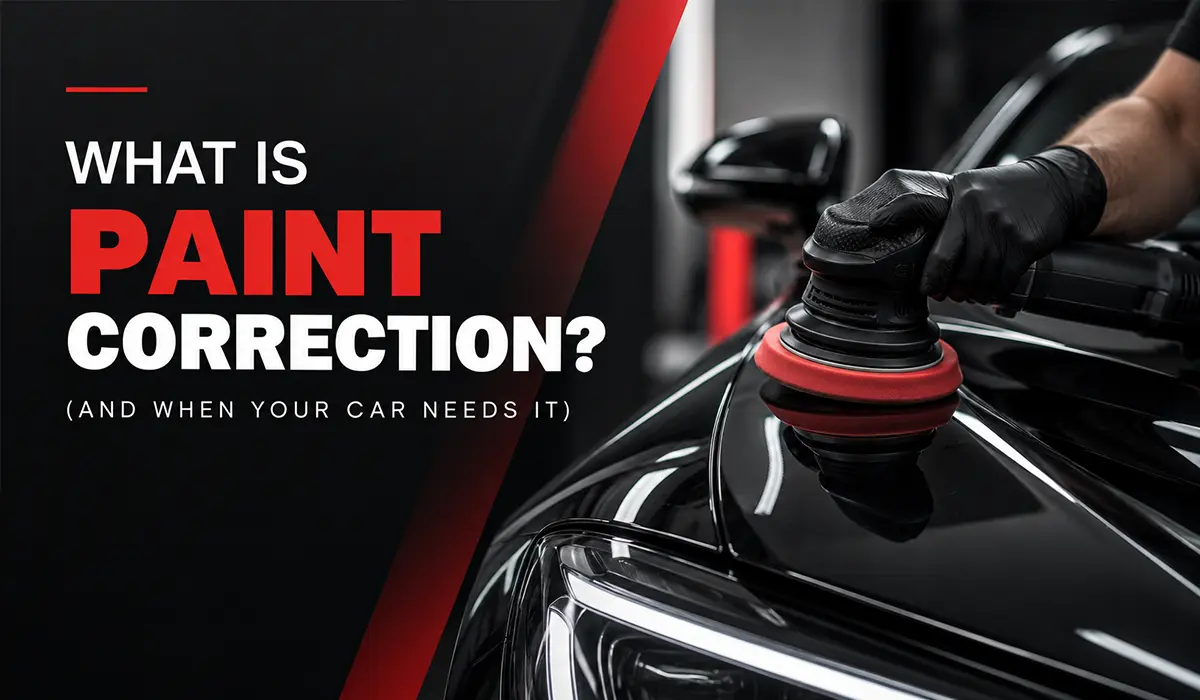
Paint correction is the process of machine polishing your vehicle’s clear coat to permanently remove swirl marks, light scratches, oxidation, and water spots, bringing back a smooth, glossy, reflective finish. It is not a wax or a filler that hides defects for a few weeks. It actually levels the surface by removing a tiny amount of clear coat, so the imperfections are gone rather than masked. Done properly, it restores your paint to near factory condition without repainting the car.
If your paint looks dull, hazy, or covered in fine spider-web scratches under the sun, paint correction is what fixes it. Here is how it works, what it can and cannot repair, and the signs your car needs it.
What Paint Correction Actually Does
Your car’s colour sits under a thin, clear protective layer called the clear coat. Over time that clear coat picks up fine scratches, swirls, and oxidation that scatter light and make the paint look dull. Paint correction uses a machine polisher with specialized compounds and pads to carefully remove a microscopic layer of that clear coat, levelling it so light reflects cleanly again.
The result is real and lasting. Because the defects are removed rather than filled, they do not reappear after a few washes the way they do with a filler product or glaze.
Paint correction fixes:
- Swirl marks, the fine cobweb scratches most visible in direct light
- Light and medium scratches that sit within the clear coat
- Oxidation and dullness that make paint look faded
- Water spots and etching
- Holograms and buffer trails left by a poor previous detail
It does not fix everything. Deep scratches that have cut through the clear coat to the colour or primer, rock chips, dents, and cracks are beyond what polishing can repair. A quick test: if your fingernail catches in a scratch, it is likely too deep for correction to fully remove, though it can often be reduced.
The Stages of Paint Correction
Paint correction is measured in stages, based on how much work the paint needs. More stages means more steps, more time, and a higher cost.
Single-stage correction. One polishing step to remove light swirls and restore gloss. Best for newer cars or well-maintained paint with minor defects. In the Calgary market this generally runs around $399 to $699.
Two-stage correction. A cutting step to remove deeper defects, followed by a polishing step to refine the gloss. Suited to daily drivers with moderate swirls and scratches. Calgary pricing generally lands around $799 to $1,299.
Three-stage correction. A more aggressive multi-step process for heavily swirled, oxidized, or neglected paint. Calgary pricing generally runs around $1,499 to $2,499 or more.
Dark colours like black tend to sit at the top of each range, since they show every defect and need slower, more careful work under proper lighting. For exact pricing on your vehicle, see our [paint correction cost guide].
How Paint Correction Works: Our Process
Good correction is careful work, not a quick buff. At CHD17 Customs, the process runs like this:
- Assessment. We inspect the paint under proper lighting to identify the swirls, scratches, oxidation, and other defects, and judge how many stages the paint needs.
- Paint thickness reading. We use a digital paint thickness gauge on every vehicle before any polishing begins. This is not optional. Clear coat is thin, and it can only be safely polished so many times in its life. Measuring first means we never remove more than the panel can safely give. Any shop quoting a multi-stage correction without reading paint thickness is guessing.
- Wash and decontamination. The vehicle is washed and decontaminated to lift dirt, iron particles, and bonded contaminants, so nothing gets dragged across the paint during polishing.
- Polishing. Depending on the paint’s condition, we use single-stage or multi-stage polishing with the right compounds and pads to remove the defects.
- Refinement. A final polishing stage refines the surface for maximum gloss, smoothness, and reflection.
That care is why correction time varies so much. Light swirls on clean, well-kept paint might take around four hours. Heavy oxidation, water etching, and holograms from a previous bad detail can take twelve hours or more.
When Does Your Car Need Paint Correction?
Here are the clear signs it is time.
You see swirl marks in the sun. If your hood or roof shows a cobweb pattern of fine circular scratches in direct light, that is swirling, usually from improper washing. It is the most common reason drivers book correction.
The paint looks dull or hazy. If your colour has lost its depth and no longer reflects cleanly, oxidation and fine scratching are scattering the light.
There are water spots or etching. Hard water and sitting rain can leave rings and marks that washing will not remove.
A previous detail left holograms. Buffer trails and hazing from a rushed shop are correctable.
You are about to get ceramic coating or PPF. This is important. A coating or film locks in whatever condition your paint is in. Correcting first means you seal a flawless finish under the coating, not the swirls. Correction before ceramic or PPF is often the difference between a good result and a great one.
You just bought the car, even new. Dealer wash swirls are common, and correction gives you a true clean slate.
You are getting ready to sell. Restored, glossy paint helps a vehicle show better and hold value.
Why Paint Thickness Measurement Matters
This is the part most people never hear about, and it is the most important safety step in correction. Every polishing pass removes a small amount of clear coat. Clear coat is finite. Remove too much over the years and the paint can fail, which is not repairable without a respray.
Measuring thickness before work begins tells the technician exactly how much material is there and how conservative to be on each panel. It is the difference between correction that safely restores your paint and aggressive polishing that quietly shortens its life. If a shop skips this step, that risk shifts entirely onto you.
Paint Correction vs Detailing vs Ceramic Coating
These often get confused, so here is the difference:
- Detailing cleans and refreshes the car. It does not remove scratches from the clear coat.
- Paint correction removes the defects from the clear coat and restores gloss. It is the repair step.
- Ceramic coating protects and seals the finish after correction. It does not remove defects.
The order matters. You correct first to fix the paint, then coat to protect it. Correction and coating work together, they do not replace each other.
Is Paint Correction Worth It?
For most drivers who care how their car looks, yes. It brings back the depth and gloss that make paint look expensive, it removes years of wash damage, and it is the essential prep step before any coating or film. Skipping correction before a ceramic coating means paying to seal in the very swirls you wanted gone.
It is worth the most on vehicles with visible swirling or dullness, any car about to receive ceramic coating or PPF, and vehicles you want to present at their best for resale.
Frequently Asked Questions
What is paint correction?
Paint correction is the process of machine polishing a vehicle’s clear coat to permanently remove swirl marks, light scratches, oxidation, and water spots, restoring a smooth, glossy finish. It removes the defects rather than hiding them, so the results last.
How do I know if my car needs paint correction?
The main sign is swirl marks, a cobweb pattern of fine scratches visible in direct sunlight. Dull or hazy paint, water spots, and hologram buffer trails are other signs. Correction is also recommended before applying ceramic coating or PPF.
Does paint correction remove deep scratches?
It removes scratches that sit within the clear coat, but not deep scratches that have cut through to the colour or primer. If your fingernail catches in a scratch, it is likely too deep to remove fully, though correction can often reduce its appearance.
How much does paint correction cost in Calgary?
Calgary pricing generally runs about $399 to $699 for single-stage, $799 to $1,299 for two-stage, and $1,499 to $2,499 or more for three-stage correction. The exact cost depends on your paint’s condition, which is why a proper shop quotes after an in-person assessment.
Is paint correction permanent?
The defects removed are gone for good, since they are polished out rather than filled. New swirls can appear over time from improper washing, so protecting the paint with a coating and washing it carefully helps the results last.
Do I need paint correction before ceramic coating?
In most cases, yes. A ceramic coating seals in whatever condition the paint is in, so correcting first means you lock in a flawless finish instead of trapping swirls under the coating for years.
How long does paint correction take?
It depends on the paint’s condition. Light swirls on well-kept paint might take around four hours, while heavy oxidation, etching, and holograms can take twelve hours or more.
Restore Your Paint in Calgary
If your paint has lost its shine or you are planning a ceramic coating or PPF, correction is the step that makes the difference. Our team assesses your paint in person, measures thickness before any work, and gives you an exact quote for your vehicle.
Learn more about our paint correction in Calgary service, or read our guides on ceramic coating cost in Calgary and PPF vs ceramic coating to plan your protection.