

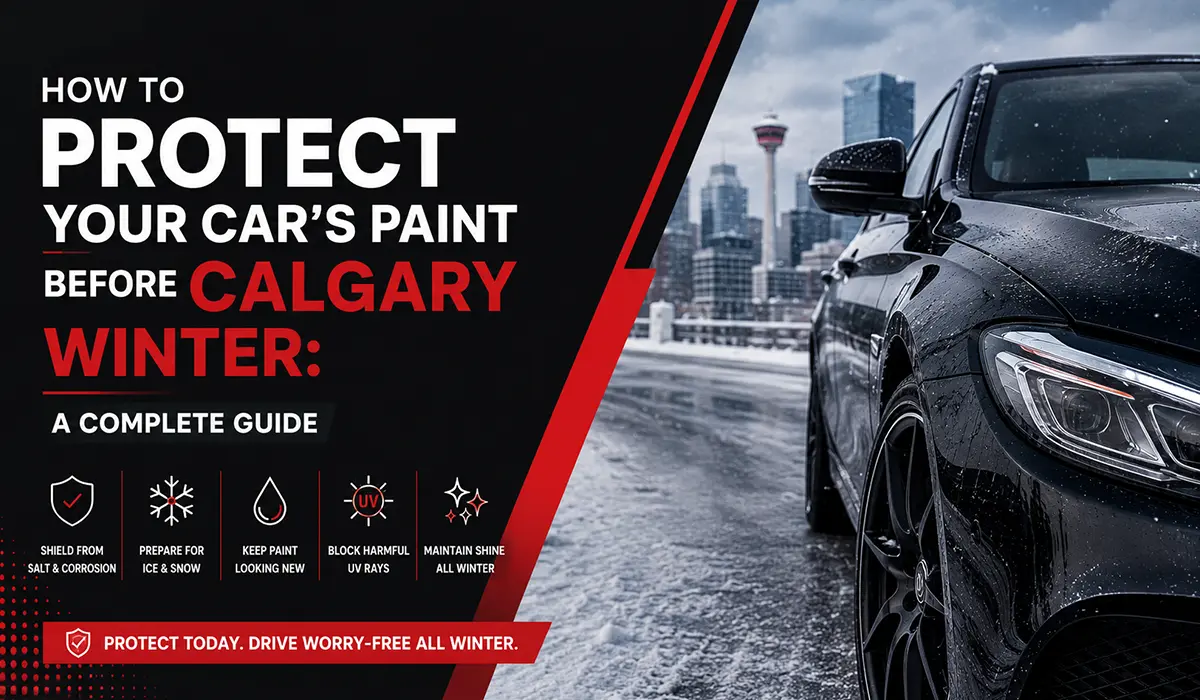
Calgary is one of the toughest cities in Canada on vehicle paint. Between the freeze-thaw cycles that start as early as October, the road salt and magnesium chloride applied on Deerfoot Trail and Stoney Trail all winter, the construction gravel that follows drivers home on the Yellowhead and the Ring Road, and the sudden Chinook temperature swings that can shift 30 degrees in a single afternoon, your car’s clear coat takes a beating that most other Canadian cities do not come close to matching.
If you drive year-round in Calgary, prepping your vehicle’s paint before winter is not optional maintenance. It is the difference between factory paint that holds its value through ten Alberta winters and a car that looks aged and faded by spring.
This guide covers everything you need to do before the cold arrives, in the right order, using the right services. Whether you are protecting a brand-new vehicle fresh off the lot or refreshing an older one before another hard season, the steps below apply.
Why Calgary Winter Is Harder on Paint Than Most Cities
Most car owners know that winter is tough on vehicles. What they do not always appreciate is why Calgary is a specific category of difficult compared to other cold-weather cities.
The first factor is road treatment. Alberta uses magnesium chloride as a primary deicer because it works at temperatures below what rock salt can handle. It is highly effective on icy roads, but it is also extremely corrosive and it clings to vehicle surfaces, including paint, trim, and wheel wells, in ways that regular salt does not. A single salted drive down Glenmore Trail can leave a corrosive film that continues attacking your clear coat for days after the roads dry.
The second factor is temperature swings. Calgary is famous for Chinooks, warm weather systems that can push temperatures from -20C to +10C in under 24 hours. These rapid temperature changes cause your car’s paint and metal panels to expand and contract repeatedly. Over time, that cycle weakens the bond between the clear coat and the paint layer beneath it, making chips and oxidation develop faster than they would in a city with more stable winter temperatures.
The third factor is highway gravel. Calgary roads are sanded heavily through winter, and commuters on Deerfoot, Stoney, and McKnight Boulevard collect rock chips at a rate that would surprise drivers from milder climates. The front bumper, hood, and headlights absorb the majority of that impact, and without protection, those panels show visible damage within a single winter.
Understanding these three factors is important because they determine which protection services matter most, and in what order you should address them.
Step 1: Start With a Full Paint Decontamination
Before any protective coating or film goes on your vehicle, your paint needs to be clean at a level beyond what a standard wash achieves. Over the course of a driving season, paint collects embedded contaminants that regular washing does not remove: iron fallout from brake dust and rail dust, tar spots from road work, industrial overspray, and bonded road grime that has baked into the clear coat through summer UV exposure.
These contaminants create a rough surface that prevents protective products from bonding properly. If you apply a ceramic coating or PPF over contaminated paint, you are locking in those particles under the protection layer, which reduces adhesion and creates an uneven finish that defeats the purpose of the investment.
A proper pre-winter decontamination involves several stages: a foam-based contact wash to remove loose surface dirt, an iron fallout remover to dissolve embedded metallic contamination, a clay bar treatment to pull out remaining bonded particles, and a surface prep wipe to ensure the paint is chemically ready for whatever goes on next.
At CHD17 Customs, we include full paint decontamination as the mandatory first step before any coating, film, or correction service. It is not an add-on. It is the foundation that determines whether every other step performs at the level it should.
Step 2: Address Paint Defects With Correction Before They Get Worse
If your vehicle already has swirl marks from automatic car washes, light scratches from parking lot contact, or the beginning of oxidation on the clear coat, Calgary winter will accelerate every single one of them. The freeze-thaw cycles and chemical exposure described above do not spare damaged paint. They exploit it.
Paint correction is the process of machine-polishing the clear coat to remove or significantly reduce surface defects before they become permanent damage. Done properly, it restores paint to a level that often matches or exceeds the condition it was in when the vehicle left the factory.
What paint correction addresses
- Swirl marks: Fine circular scratches caused by improper washing technique, automatic wash brushes, or wiping a dirty surface with a dry cloth.
- Light scratches: Surface-level marks that have not penetrated through the clear coat into the base paint.
- Water spots: Mineral deposits from hard water or melting snow that etch into the clear coat if left untreated.
- Oxidation: Dull, chalky areas that develop when UV exposure breaks down the clear coat’s chemical structure over time.
What paint correction cannot fix is damage that has cut through the clear coat into the colour layer or the primer beneath. Those cases require spot respray or panel repairs, which is a separate conversation.
The right time to do paint correction is before winter, not after. Once a corrected surface is protected with ceramic coating or PPF, the protection layer preserves that corrected finish through the season. Waiting until spring means the paint absorbs another winter of salt, gravel, and temperature stress in a compromised state.
Step 3: Apply Paint Protection Film to High-Impact Areas
Paint Protection Film, commonly called PPF, is a thick thermoplastic urethane film that is applied directly to your vehicle’s painted surfaces. It is the only protection that physically absorbs the impact of rock chips, gravel strikes, and road debris before they can reach your paint.
No other product does this. Ceramic coating does not stop rock chips. Car wax does not stop rock chips. PPF does, and in Calgary, that function matters more than it does in most Canadian cities.
Where to apply PPF in Calgary
Full-vehicle PPF is available and is the most comprehensive option for luxury, exotic, and high-value vehicles. For most Calgary drivers, a partial or zone-based approach delivers the best protection per dollar spent.
The areas that absorb the most highway impact are:
- Full front bumper, including the lower lip and splitter
- Hood (full or partial, at minimum the leading 24 inches)
- Front fenders
- Side mirrors
- Headlights and fog lights
- Rocker panels and door edges
These are the zones that face oncoming traffic, collect the highest concentration of stone chips, and show the most damage on Calgary-driven vehicles within two to three winters.
PPF features that matter in Alberta’s climate
- Self-healing: Quality PPF films have a topcoat that heals light surface scratches and scuffs when exposed to heat, including sun warmth, which is available even in a Calgary winter during Chinook periods.
- UV resistance: Alberta’s elevation and the long summer UV season are harder on films than people expect. Quality PPF is rated to resist yellowing and hazing under UV exposure for the full duration of its warranty period.
- Temperature stability: Films installed in Calgary need to maintain adhesion through -40C winters without lifting at the edges and through +30C summers without bubbling. The films CHD17 uses are rated for both extremes.
- Self-cleaning topcoat: Hydrophobic-surface PPF keeps road salt and grime from bonding to the film surface, which makes winter maintenance significantly easier.
CHD17 Customs installs XPEL and other premium-grade PPF brands with computer-cut patterns specific to each vehicle model. No trimming on the vehicle means no scoring the paint beneath and no visible cut lines on finished panels.
Step 4: Add Ceramic Coating for Chemical and UV Defense
Where PPF handles physical impact, ceramic coating handles everything else: road salt corrosion, UV oxidation, bird dropping acids, tree sap, and the general chemical environment your car moves through every day.
Ceramic coating is a liquid polymer that bonds chemically to your clear coat, forming a glass-like layer that is significantly harder than the clear coat itself. Once cured, it creates a hydrophobic surface that causes water, salt, and road contamination to bead off rather than bond and sit.
In a Calgary winter context, this matters for several specific reasons:
- Salt and magnesium chloride repulsion: Deicers cannot bond as effectively to a ceramic-coated surface. Instead of sitting on your paint through a Chinook day or overnight in the garage, they rinse away with far less contact time.
- Simplified winter washing: A ceramic-coated car is dramatically easier to maintain clean through winter. The dirt and salt that accumulate between washes come off with far less effort and without the aggressive scrubbing that itself causes swirl marks.
- UV protection year-round: Calgary summers deliver intense UV at high altitude. Ceramic coating provides sustained UV protection that prevents the oxidation and colour fade that begin immediately once factory paint is exposed to unfiltered sun.
- Long service life: A professionally applied ceramic coating from CHD17 lasts multiple years, making it a single-investment solution rather than a seasonal product that needs reapplication.
Ceramic coating and PPF together
The most effective protection approach is PPF on high-impact zones with ceramic coating applied over the PPF and across the rest of the vehicle. This combination gives you physical protection where stone chips are a risk and chemical protection everywhere else. The ceramic coating also makes the PPF surface easier to maintain, since the hydrophobic layer on top of the film means the film surface stays cleaner and is less vulnerable to the water spotting that can affect uncoated PPF over time.
Many Calgary drivers who protect both a daily driver and a weekend or seasonal vehicle choose this combination approach for the daily driver and full PPF for the vehicle they care most about keeping in concours condition.
Step 5: Consider Ceramic Window Tint for Year-Round Comfort
Window tint often gets positioned as a summer product, and in Calgary, that framing undersells it. Ceramic window film provides UV protection that matters in every season, because UV rays are present in Calgary even on overcast winter days and are a primary cause of interior fading, dashboard cracking, and leather degradation.
Standard dyed window films block some light but fail at heat rejection and fade over time. Ceramic window films, including the XPEL and 3M Ceramic IR films installed at CHD17, block up to 99% of UV radiation and reject significant infrared heat without the dark appearance required by older film technologies. This means you can achieve meaningful interior protection within Alberta’s legal tint limits.
Alberta window tint law quick reference
| Window | Legal Status | Notes |
| Front windshield | No tint allowed | Factory glass only (visor strip permitted at top) |
| Front side windows | No aftermarket tint | Any violation: fines up to $224/window |
| Rear side windows | Any darkness permitted | Side mirrors required if rear is tinted |
| Rear window | Any darkness permitted | Must have both side mirrors |
Alberta is one of the stricter Canadian provinces for front window tinting. CHD17 always installs to legal limits for Calgary vehicles. We will not install film that puts you at risk of a fine.
Step 6: Protect Your Windshield Before Winter Gravel Season
Windshield protection film is the most overlooked pre-winter service available in Calgary, and it is the one where the cost-versus-benefit argument is clearest.
A windshield chip repair costs anywhere from $80 to $150 per chip. A crack that spreads requires a full windshield replacement, which can cost $400 to $900 or more depending on the vehicle. Calgary roads are aggressively sanded through winter, and the volume of rock and gravel that becomes airborne on the Trans-Canada, Deerfoot, and Stoney Trail means that windshield chips are not a question of if but when for most daily drivers.
Windshield protection film is a clear urethane film applied to the exterior surface of the glass. It absorbs rock impacts, prevents chips from penetrating the glass, and maintains optical clarity because it is specifically engineered for glass surfaces. Unlike PPF on painted panels, windshield film is not visible in normal driving conditions.
For Calgary drivers who commute on highways daily, windshield protection film pays for itself after preventing one replacement. For those who park outside rather than in a garage, the combination of gravel and temperature cycles that cause chips to crack through glass makes it even more worthwhile.
When to Book Your Pre-Winter Protection in Calgary
The answer is earlier than most drivers think. CHD17 recommends booking pre-winter paint protection services in August or September. Here is why timing matters:
- Ceramic coating cure time: A professional ceramic coating requires 24 to 48 hours of controlled-environment curing immediately after application, followed by a break-in period before the vehicle is exposed to rain, salt, or washing. The window for doing this properly closes as Calgary temperatures drop.
- PPF installation time: Depending on the coverage area, a full PPF installation can take one to five days. August and September availability is significantly better than October, when shops fill up with last-minute bookings.
- New car protection: If you have recently purchased a vehicle, coating it before its first Calgary winter is the single most effective thing you can do to preserve its condition and resale value. Every unprotected week is an opportunity for the first paint damage to occur.
Vehicles brought in before October typically qualify for same-week appointments. By mid-October, most quality shops in Calgary are booked two to three weeks out.
How to Maintain a Protected Vehicle Through Calgary Winter
Protection services do not eliminate the need for winter maintenance. They make it easier and more effective.
A ceramic-coated or PPF-wrapped vehicle still needs to be washed regularly through winter. The difference is that the protective surface means contaminants come off more easily, do not bond to paint the way they do on unprotected surfaces, and cannot cause the chemical etching that salt and bird droppings produce on bare clear coat.
Winter washing guidelines for protected vehicles
- Rinse the vehicle thoroughly before contact washing to avoid dragging bonded salt and grit across the protective surface.
- Use a pH-neutral car wash soap. Dish soap and many commercial soaps are too alkaline and will degrade ceramic coating over time.
- Avoid automatic touchless washes that use high-strength chemical cleaners, as these are often formulated to strip everything from the paint surface, including coating.
- After washing, a quick coating maintenance spray can help restore hydrophobic performance if you notice water is no longer beading and sheeting properly.
- Keep road salt off the vehicle for more than 48 to 72 hours at a time when possible, particularly during freeze-thaw periods when salt sits in a wet, concentrated state against surfaces.
Pre-Winter Paint Protection: Complete Service Summary
| Service | What it protects against | Timing | Who needs it |
| Paint decontamination | Removes embedded contamination before protection | Before any other service | Everyone |
| Paint correction | Swirl marks, oxidation, light scratches | Before coating or PPF | Vehicles with any visible defects |
| PPF (partial or full) | Rock chips, gravel impacts, door dings | Any time of year; book early | Highway drivers, new cars, trucks |
| Ceramic coating | Salt, UV, chemicals, bird droppings, water spots | Before winter; cure needed | All daily-driven vehicles |
| Ceramic window tint | UV, interior fading, heat | Year-round | Vehicles without factory UV glass |
| Windshield protection film | Rock chip penetration, crack spreading | Before winter gravel season | Highway commuters, open parking |
Frequently Asked Questions
Is it too late to protect my car if winter has already started?
No, but your options narrow. Once temperatures drop consistently below 5C, the conditions for applying ceramic coating properly become more restricted. PPF and windshield protection film can still be installed through winter in a controlled shop environment. The decontamination and correction work can also be done in any season. The ideal window is August through October for the full protection package.
Can I combine PPF and ceramic coating on the same vehicle?
Yes, and this is the recommended approach. PPF goes on first in the areas that need physical chip protection. Ceramic coating is then applied over the entire vehicle, including over the PPF. The ceramic layer makes the PPF hydrophobic and easier to maintain, and it provides chemical and UV protection across the areas of the car that do not have PPF coverage.
How long does ceramic coating last in Calgary’s climate?
A professionally applied coating from CHD17 lasts multiple years under normal Calgary driving conditions. The specific longevity depends on the coating product and grade selected, how the vehicle is maintained through winter, and whether the vehicle lives outside or in a garage. We offer coatings with both 3-year and 5-year warranty options. Calgary’s climate, particularly the magnesium chloride roads, is more demanding than moderate-weather cities, which is why we recommend annual maintenance inspections to verify coating performance.
Does PPF prevent all rock chips?
PPF dramatically reduces rock chip damage and will stop the majority of highway gravel strikes from reaching your paint. At very high speeds, a large stone hitting at a direct angle can still penetrate the film. What PPF ensures is that the film absorbs the impact rather than your paint, and in most cases, the film’s self-healing properties allow the surface damage to the film itself to disappear with heat exposure.
Does windshield protection film affect visibility?
No. Windshield protection film installed by a professional is optically clear and does not affect your view of the road. It is engineered specifically for glass surfaces and does not produce the haze or distortion that some older films are known for. After installation, most drivers cannot tell it is there.
How do I book a pre-winter protection package with CHD17 Customs?
Call or text us at +1 (403) 478-2217 or submit a request through our contact page. We offer free quotes and can recommend the right combination of services based on your vehicle, how you drive in Calgary, and your budget. Our Calgary shop is located at 3640 26 St NE Unit B.