

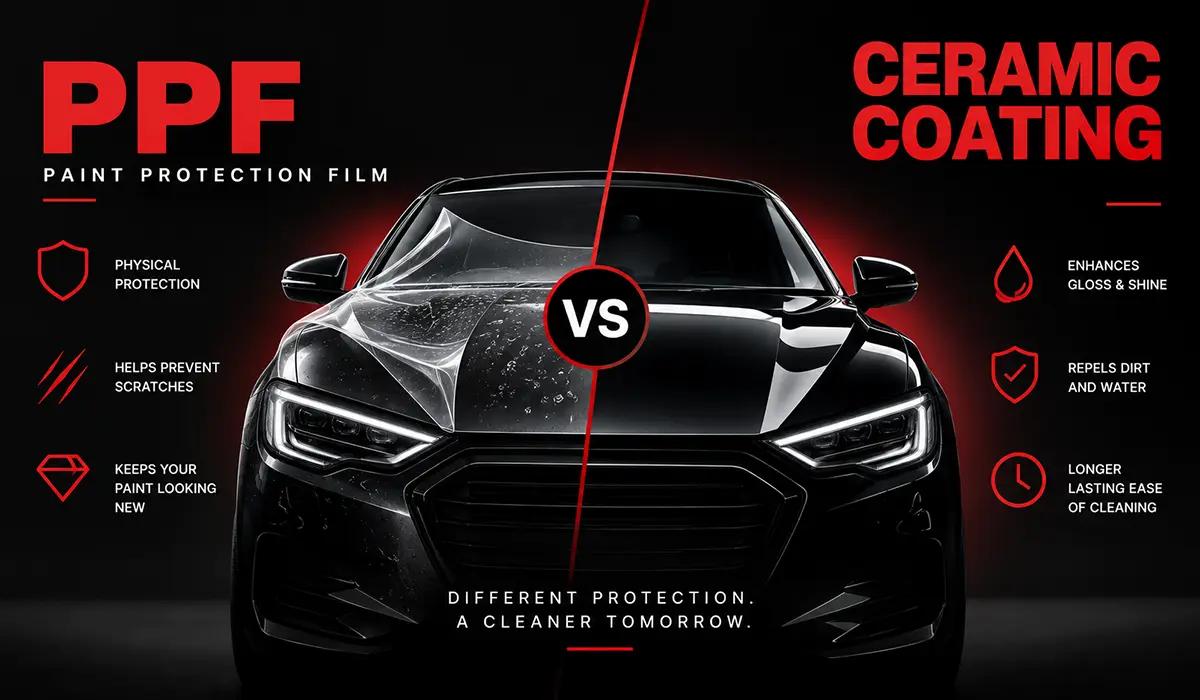
Paint protection film and ceramic coating are not really competitors. They protect against different things. Paint protection film (PPF) is a physical shield that absorbs rock chips and scratches, while ceramic coating is a chemical shield that adds gloss and guards against UV, salt, and stains. If your main worry is gravel and rock chips, PPF is better. If you want a glossy, easy-to-wash finish that resists chemicals and fading, ceramic is better. For full protection, many Calgary drivers use both together.
Here is a clear, honest comparison so you can choose the right one for your vehicle, your driving, and your budget.
PPF vs Ceramic Coating at a Glance
| Feature | Paint Protection Film (PPF) | Ceramic Coating |
|---|---|---|
| What it is | A thick urethane film applied over the paint | A liquid polymer that bonds to the paint |
| Main job | Absorbs rock chips and physical impacts | Adds gloss and resists chemicals, UV, and water |
| Rock chip protection | Yes, this is its strength | No |
| Chemical and salt resistance | Good | Excellent |
| UV protection | Good | Excellent |
| Gloss and shine | Slight enhancement | Deep, glassy shine |
| Water beading | Good, better on ceramic-topped film | Excellent |
| Self-healing scratches | Yes, with heat | No |
| How long it lasts | 5 to 10 years | 2 to 5 years or more |
| Starting cost at CHD17 | From $649 (partial front) | From $749 |
| Best for | Highway driving, rock chip protection | Gloss, easy washing, chemical and UV defence |
What Is Paint Protection Film?
Paint protection film, also called a clear bra, is a clear urethane film applied over your painted panels. It is thick enough to absorb the impact of rocks and gravel so the hit never reaches your paint. Most quality film is self-healing, which means light scratches disappear when the film gets warm from the sun or warm water.
Think of PPF as an invisible screen protector for your car. It takes the physical damage that would otherwise chip and scratch your finish. See how our PPF installation in Calgary covers the high impact areas of your vehicle.
What Is Ceramic Coating?
Ceramic coating is a liquid polymer, rich in silica, that chemically bonds to your factory paint and cures into a hard, glass-like layer. It does not sit on top like wax. It becomes part of the surface. That bonded layer gives you a deep gloss, strong water beading, and real resistance to UV, road salt, and chemical staining.
Think of ceramic as a durable shield that keeps your paint glossy and makes washing much easier. What it cannot do is stop a rock chip. Learn more about our ceramic coating in Calgary and the protection grades we offer.
Head to Head: Which Protects Better?
Rock chips and physical damage
PPF wins, clearly. This is the one thing ceramic coating cannot do. On Calgary highways, flying gravel is the number one threat to your front end, and only the thick urethane film absorbs those impacts. If rock chips are your concern, film is the answer.
Road salt and chemicals
Both help, ceramic has the edge for surface staining. Ceramic coating creates a slick, chemical-resistant surface that road brine, bird droppings, and sap struggle to grip or etch. PPF also resists these, and on covered panels it protects the paint underneath completely. For a full seasonal plan, see our guide to protecting your paint before Calgary winter.
UV and fading
Both protect, ceramic is the stronger UV barrier across the whole car. Calgary gets strong sun year round, and ceramic coating slows oxidation and fading everywhere it is applied. PPF protects UV on the panels it covers.
Gloss and looks
Ceramic wins for shine. A coating gives a deep, glassy, reflective finish that film does not match on its own. Modern PPF looks great and stays nearly invisible, but if pure gloss is your goal, ceramic delivers it.
Easier washing
Ceramic wins. The hydrophobic surface sheds water and dirt, so a coated car stays cleaner and washes faster. This is one of the most noticeable day-to-day benefits.
Durability
PPF lasts longer. Quality film lasts 5 to 10 years. A ceramic coating typically lasts 2 to 5 years or more depending on the grade. Both are long-term investments compared to wax.
Self-healing
PPF wins. Only the film repairs its own light scratches with heat. Ceramic is hard and scratch-resistant, but it does not self-heal.
Cost Comparison in Calgary
At CHD17 Customs, here is where the two start:
Ceramic coating starts at $749, with durable protection for around 5 years, including an exterior wash and decontamination as part of the prep. See our full ceramic coating cost in Calgary breakdown.
Paint protection film runs from $649 for partial front coverage up to $4,499 for a full car wrap, with mid packages at $999 and $1,699 depending on how much of the front end you cover. For every package and figure, read our full PPF price breakdown.
Ceramic coating is the lower-cost entry to serious paint protection, and it covers the whole car. PPF costs more as you add coverage, but it is the only option that stops physical chips. Many drivers protect the high-impact front end with film and coat the rest of the car with ceramic, which brings us to the best answer for most people.
Can You Use PPF and Ceramic Coating Together?
Yes, and for many vehicles this is the ideal setup. The two products cover each other’s gaps. Film handles the rock chips and physical impacts on the front end. Ceramic handles the gloss, UV, salt, and easy washing across the whole car.
You can even apply ceramic coating on top of the film. That adds hydrophobic slickness and gloss to the film itself, makes it easier to clean, and helps protect the film from staining. This combination gives you the most complete protection available: impact resistance where you need it, and a glossy, chemical-resistant finish everywhere. On existing vehicles we often recommend paint correction first, so the coating bonds to a flawless surface.
Which Is Better for Your Vehicle?
The right choice depends on how you drive and what you want to prevent.
Choose PPF if you drive a lot of highway kilometres, want to stop rock chips and gravel damage, own a new or leased vehicle you want to keep pristine, or want to protect resale value on high-impact areas.
Choose ceramic coating if you want a deep glossy finish, easier and faster washes, strong UV and chemical protection across the whole car, and the lower-cost way into real long-term protection.
Choose both if you want complete protection, plan to keep the vehicle for years, or own a luxury, exotic, or high-value car where you want the front end armoured and the whole body glossy and sealed.
A simple rule: if you can only pick one and rock chips worry you most, get PPF on the front. If chips are less of a concern and you want gloss and easy maintenance, get ceramic. If budget allows, film the front and ceramic the rest.
Frequently Asked Questions
What is the difference between PPF and ceramic coating?
PPF is a thick film that physically absorbs rock chips and scratches. Ceramic coating is a liquid that bonds to the paint and adds gloss while resisting UV, salt, and chemicals. Film protects against impacts, ceramic protects against chemical and environmental damage, and they are often used together.
Which is better, PPF or ceramic coating?
It depends on your goal. PPF is better for stopping rock chips and physical damage. Ceramic coating is better for gloss, easy washing, and UV and chemical resistance. For full protection, many drivers use both, with film on the front end and ceramic over the rest of the car.
Does ceramic coating protect against rock chips?
No. Ceramic coating resists UV, salt, water spots, and chemical staining, but it cannot stop a rock chip. Only paint protection film absorbs physical impacts from gravel and stones.
Can you put ceramic coating over PPF?
Yes. Applying ceramic coating on top of paint protection film adds gloss and hydrophobic slickness to the film, makes it easier to clean, and helps protect the film from staining. It is a popular way to combine both.
Which lasts longer, PPF or ceramic coating?
PPF lasts longer, typically 5 to 10 years. Ceramic coating usually lasts 2 to 5 years or more depending on the grade and care. Both last far longer than wax.
Is PPF or ceramic coating more expensive?
It depends on coverage. At CHD17 Customs, ceramic coating starts at $749 and covers the whole car, while PPF runs from $649 for partial front coverage up to $4,499 for a full car wrap. Full car PPF is the more expensive option because it uses much more film and labour.
Do I need both PPF and ceramic coating?
Not necessarily, but many drivers benefit from both. Film protects high-impact areas from chips, and ceramic keeps the whole car glossy and easy to wash while resisting UV and salt. Together they give the most complete protection, especially for Calgary driving.
Get Expert Advice in Calgary
Not sure which is right for your vehicle? Our team will look at your car, ask how you drive, and recommend the coverage that makes sense for your budget and goals. No pressure, just a clear answer.