

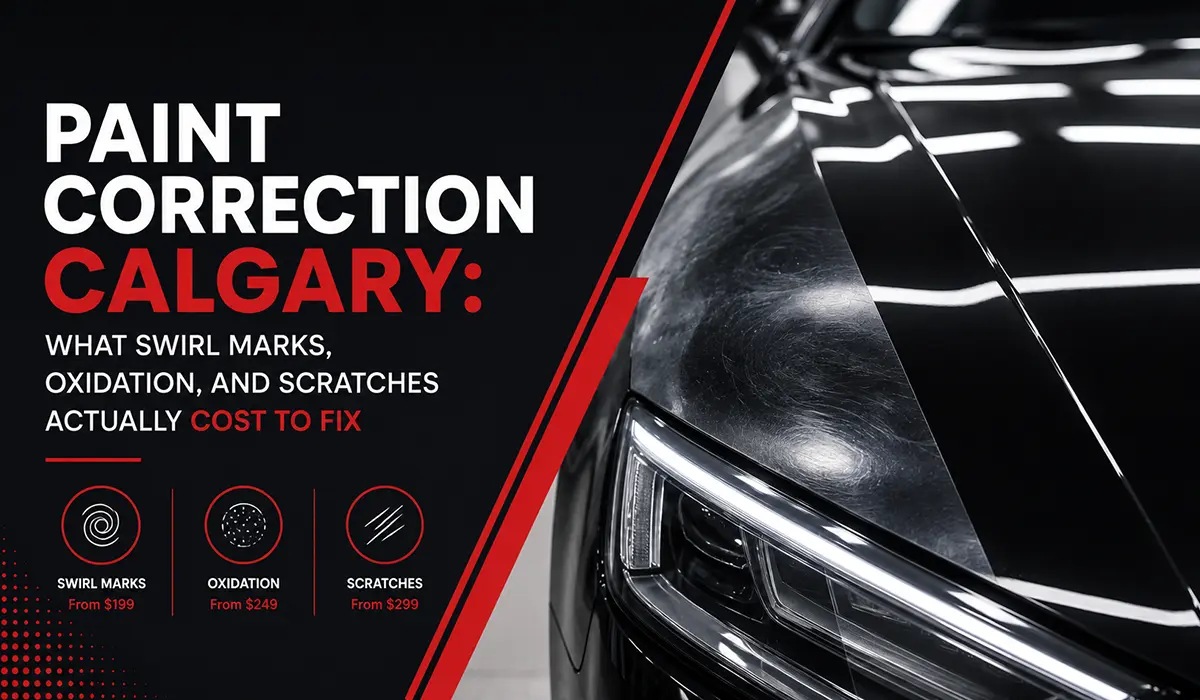
Paint correction is one of the most misunderstood services in the automotive detailing world, and in Calgary it is also one of the most underused. Most vehicle owners notice swirl marks, dull paint, or the beginning of oxidation and assume it is just normal wear that cannot be reversed. They wash the car, apply a coat of wax, and accept the result.
Paint correction reverses it. Properly executed, it restores a vehicle’s clear coat to a condition that frequently matches or surpasses how the paint looked when the car left the factory. The process removes swirl marks, oxidation, water etching, and light scratches that wax conceals only temporarily. The corrected paint is the actual paint surface, not a product layered over damage.
This guide explains exactly what paint correction fixes, what it cannot fix, how the stages differ from each other, what the process costs in Calgary, and when to book it. If you have ever wondered whether your vehicle’s paint is actually restorable or whether you are living with damage that does not need to be there, this is where to find out.
What Paint Correction Is and How It Works
Paint correction is a machine polishing process that removes defects from a vehicle’s clear coat layer. The clear coat is the outermost layer of your vehicle’s paint system, a transparent hard coating applied over the colour layer that gives paint its gloss, depth, and protection.
Most paint defects exist within the clear coat rather than beneath it. Swirl marks, fine scratches, water spots, and mild oxidation are all surface-level damage to the clear coat’s structure. Paint correction works by using a machine polisher with a foam or microfibre cutting pad and an abrasive compound to remove a controlled amount of the clear coat surface. When that surface is levelled and refined in stages, the defects are gone and what remains is a flat, reflective, undamaged clear coat surface.
The analogy that helps most people understand it is sanding wood. If you have a scratched wooden floor, you sand the surface down to remove the scratches and then refinish it. Paint correction does the same thing on a microscopic scale. The abrasives remove tens of microns of clear coat to find an undamaged layer beneath the defects.
What this means for your vehicle’s paint thickness
Every paint correction removes a small amount of clear coat. A vehicle’s clear coat is typically 50 to 90 microns thick, and a professional paint correction removes two to five microns per stage depending on the compound and pad aggressiveness used. A vehicle that receives a professional correction once or twice over its lifespan loses a negligible fraction of its total clear coat thickness. A vehicle that receives aggressive repeated corrections or that goes to an inexperienced operator who uses incorrect compound-and-pad combinations can lose clear coat faster than necessary.
This is one of the reasons professional paint thickness measurement is part of a proper correction process. Before cutting into any panel, an experienced technician reads the paint thickness gauge across the vehicle to know how much material is available and to set the appropriate correction approach for each panel.
CHD17 uses a digital paint thickness gauge on every vehicle before correction work begins. This is not optional. It ensures we never cut more than the panel can safely give and guides which panels need a conservative single-stage approach versus where a more aggressive multi-stage correction is appropriate.
What Each Defect Type Is and Whether It Can Be Corrected
Before investing in paint correction, it helps to understand what you are actually looking at on your vehicle’s paint and whether it falls within the range correction can address.
Swirl marks
Swirl marks are the most common paint defect on Calgary vehicles. They appear as fine circular or arc-shaped scratches that are most visible in direct sunlight or under artificial light. Under a focused inspection light, a swirl-marked hood or roof looks like a cobweb of fine lines radiating in overlapping circular patterns.
Swirl marks are caused by improper washing technique, automatic car wash brushes, wiping a dusty panel with a dry or barely damp cloth, chamois drying in circular motions, and using abrasive polishing pads without proper lubrication. The vast majority of Calgary vehicles that have been washed at automatic washes or detailed by hand without proper technique will show measurable swirl marks under inspection.
Correctable by paint correction: Yes, in almost all cases. Swirl marks are typically shallow surface abrasions in the clear coat and respond well to single-stage or two-stage correction.
Fine scratches
Fine scratches are linear marks caused by contact with hard objects: a zipper on a jacket sleeve dragged along the door, keys catching a panel edge, a shopping cart impact at low speed, or debris scratched across the surface during washing. They look like individual lines rather than the clustered web pattern of swirl marks.
Whether a fine scratch is correctable depends on its depth. A scratch that exists within the clear coat layer, meaning it has not cut through to the colour layer or primer beneath it, can be polished out or reduced significantly. A scratch that has cut through the clear coat to expose the colour layer or bare metal is beyond what polishing can address and requires touch-up paint or respray.
The fingernail test is a practical field check: if you run a fingernail across the scratch and it catches or snags, the scratch has depth that correction alone may not fully remove. If your nail slides across without catching, the scratch is likely within the clear coat and correctable.
Correctable by paint correction: Yes if the scratch is within the clear coat. No if it has cut through to the colour layer or primer.
Water spots and mineral etching
Water spots form when water evaporates off the paint surface and leaves behind the mineral deposits it contained, primarily calcium and magnesium carbonates from Calgary’s hard tap water, as well as alkaline contaminants from road spray and industrial fallout. At the surface level, water spots appear as faint circular marks. Left untreated, especially under Calgary’s summer UV, those mineral deposits etch into the clear coat and create permanent pitting.
Early-stage water spotting that has not yet etched into the surface can often be removed with a chemical treatment or light polishing. Water spots that have etched into the clear coat require mechanical paint correction to level the surrounding surface and remove the etching. Severe etching that has penetrated the full clear coat depth is not correctable by polishing.
Correctable by paint correction: Usually yes for etched spots that have not penetrated the full clear coat depth. Chemical pre-treatment may also be applied first for light cases.
Oxidation
Oxidation is what happens when UV radiation and atmospheric oxygen break down the clear coat’s chemical structure over time. It begins as a slight loss of gloss and depth, progresses to a chalky or hazy appearance, and in advanced cases produces a flat, powdery surface with no reflectivity remaining.
Mild to moderate oxidation is very responsive to paint correction. The polishing process removes the oxidised surface layer of the clear coat to reveal the undamaged material beneath it. Heavy oxidation on vehicles that have been left unprotected for extended periods can sometimes be addressed through aggressive multi-stage correction, but in severe cases where the oxidation has consumed the full clear coat depth, respray is the only option.
Calgary’s combination of high-altitude UV and the summer to winter UV cycling that occurs with variable cloud cover makes oxidation develop faster here than in lower-altitude cities with more consistent seasonal cloud cover. Vehicles parked outdoors year-round without protection show oxidation on exposed panels within three to five years without protection.
Correctable by paint correction: Yes for mild to moderate oxidation. Severe oxidation that has consumed the full clear coat depth requires respray.
Hologramming and buffer trails
Hologramming refers to the distinctive swirl pattern left in paint by a rotary machine polisher used incorrectly or with the wrong compound-and-pad combination. It looks similar to swirl marks but has a more pronounced, high-frequency pattern that is very visible under inspection lighting. It is caused by heat and friction from incorrect polishing technique and is itself a form of paint damage, often done at a body shop or by an inexperienced detailer.
Correctable by paint correction: Yes. Hologramming and buffer trails are clear coat surface defects that respond to correction in the same way swirl marks do.
What paint correction cannot fix
- Deep scratches through the colour layer or primer: visible paint colour or bare metal in the scratch line, requires touch-up paint or panel respray.
- Dents and panel damage: paint correction is a surface process only. It does not address structural deformation.
- Rock chips: chips that have broken through the paint film to the primer or metal are beyond polishing. Touch-up paint or PPF over existing chips is the standard approach.
- Advanced clearcoat failure: peeling, flaking, or delaminating clear coat cannot be polished back. The clear coat must be reapplied, which is a body shop service.
- Deep acid etching: bird droppings or industrial acid that has etched fully through the clear coat depth leaves a crater that correction cannot level.
Paint Correction Stages: Single-Stage, Two-Stage, and Multi-Stage Explained
Paint correction is not one process applied identically to every vehicle. The number of stages required depends on the severity of the defects, the condition of the clear coat, and the level of finish quality the vehicle needs. Understanding the stages helps you have an informed conversation with any shop about what your specific vehicle actually requires.
Single-stage paint correction
Single-stage correction uses one round of machine polishing with a moderately aggressive compound and an appropriate pad to address light to moderate defects. It removes surface contamination, light swirl marks, mild water spotting, and the beginning of oxidation. It produces a significant improvement in gloss and clarity without removing as much clear coat as a multi-stage process.
Single-stage correction is appropriate for vehicles in relatively good condition that have accumulated normal washing-related swirl marks and light surface dullness, vehicles with thinner clear coat readings where a conservative approach is warranted, vehicles receiving correction as a one-time refresh before a coating application, and newer vehicles whose paint has not yet accumulated severe defects.
Typical defect removal rate: 50 to 70 percent of surface defects, depending on severity. The most visible swirl marks and haziness will be eliminated. Very fine or lighter defects may see complete removal.
Two-stage paint correction
Two-stage correction is the standard approach for vehicles with moderate to heavy swirl marks, visible oxidation, water etching, or hologramming from a previous poor polish. The first stage uses a more aggressive compound and cutting pad to remove the majority of defects. The second stage uses a finer polish and finishing pad to remove any marks left by the first stage and to refine the surface to a high gloss.
Two-stage correction is the most commonly requested level at CHD17. It is appropriate for most Calgary daily drivers that have been through several Alberta winters and summers, vehicles that have been washed at automatic car washes repeatedly, and vehicles being prepared for ceramic coating or PPF where the finish quality under the protection layer needs to be as close to perfect as possible.
Typical defect removal rate: 80 to 95 percent of surface defects. Most swirl marks, moderate scratches, oxidation, and water etching will be fully removed. Very deep scratches that exist at the colour layer boundary may be reduced but not fully eliminated.
Multi-stage paint correction
Multi-stage correction, sometimes called a full or ultimate paint correction, involves three or more polishing stages starting with a heavy cutting compound and progressing through increasingly fine products to achieve the closest possible approach to defect-free paint. This level of correction is done for vehicles with severe oxidation or heavy defect loads, show cars or concours vehicles where the standard is near-perfection under dedicated inspection lighting, high-value exotic or collector vehicles being prepared for long-term protection, and vehicles where the previous paint history suggests extensive damage from poor care.
Typical defect removal rate: 90 to 99 percent of surface defects, limited only by the depth of defects relative to remaining clear coat thickness. A multi-stage correction on a well-cared-for vehicle with surface-level defects can achieve a finish that a professional inspector cannot distinguish from brand-new paint.
What Paint Correction Costs in Calgary: Real Pricing Ranges
Paint correction pricing varies based on vehicle size, defect severity, number of stages required, and the time required to complete the work properly. The ranges below reflect professional-grade work at an equipped shop with proper lighting, machine tools, and trained technicians. They are not comparable to budget mobile detailers who may offer a cheaper service using consumer-grade pads and compounds without the lighting or measurement equipment needed to assess results accurately.
| Service | Sedan / coupe | SUV / truck | What is included |
| Single-stage correction | $300–$500 | $400–$650 | Full decontamination wash, clay bar, one-stage machine polish, panel wipe-down. Best for light swirl marks and pre-coating prep on newer vehicles. |
| Two-stage correction | $500–$900 | $650–$1,100 | Full decontamination, clay, aggressive cutting stage, refining stage, paint thickness measurement throughout, inspection under lighting. Standard for most Calgary daily drivers. |
| Multi-stage correction | $900–$2,000+ | $1,100–$2,500+ | Full decontamination, clay, three or more polishing stages, panel-by-panel defect mapping, final inspection under dedicated lighting. For show prep, exotics, or severe oxidation cases. |
| Paint correction + ceramic coating | $1,200–$2,800 | $1,500–$3,500+ | Correction to appropriate stage followed immediately by professional ceramic coating application. The correction and coating should always be done in sequence by the same shop. |
| Paint correction + PPF | Quote-based | Quote-based | Correction required before PPF application. Pricing depends on coverage area. Correcting paint before PPF is mandatory: any defect under the film is locked in permanently. |
These are Calgary market ranges for professional work. Prices at any specific shop vary based on the products used, the technician’s experience level, the condition of the vehicle on arrival, and shop overhead. A quote from CHD17 after an in-person assessment will give you an exact number for your specific vehicle and its actual condition.
Why paint correction pricing is not fixed like a service menu item
A professional correction shop quotes based on the vehicle’s condition because the labour required changes significantly depending on what the paint actually needs. A vehicle with light swirl marks on a clean, cared-for five-year-old paint system might need four hours of polishing. A vehicle with heavy oxidation, water etching, and hologramming from a previous bad detail could require twelve or more hours of work to address properly.
Shops that quote a fixed price without seeing the vehicle are either guessing or planning to do the same light polish regardless of what the paint actually needs. An inspection-based quote reflects honest assessment of the actual work involved.
Why Paint Correction Must Come Before Ceramic Coating or PPF
Paint correction and protective coatings are not interchangeable services that can be done in any order. The sequence is mandatory: correct the paint first, then protect it. Understanding why helps clarify what you are actually paying for in a combined package.
Why correction before ceramic coating is non-negotiable
Ceramic coating bonds to the clear coat surface and forms a hard, semi-permanent layer over it. Any defect that exists on the clear coat when the coating is applied gets sealed beneath it. The coating does not fill or hide those defects. Under direct sunlight, swirl marks and oxidation are just as visible through a ceramic coating as they are on uncoated paint, because the coating is transparent. The hydrophobic gloss of a fresh ceramic coating can temporarily hide defects by adding optical depth, but this effect fades as the coating cures, and the defects become visible again.
More importantly, a ceramic coating that is applied over contaminated or defective paint will not bond evenly across the surface. The coating chemistry requires a clean, flat, chemically prepared clear coat to achieve a consistent molecular bond. Defects and contamination interrupt that bond, which creates weak points that allow environmental damage to penetrate and reduces the coating’s functional lifespan.
Every ceramic coating installation at CHD17 includes a mandatory paint decontamination stage. Whether correction is also required before coating depends on the vehicle’s current paint condition, which is why we assess every vehicle before providing a coating quote.
Why correction before PPF is mandatory
Paint Protection Film, once applied, stays on the vehicle for five to ten years. Any paint defect beneath the film when it is installed remains beneath the film for the full duration of the installation. There is no way to access or address that defect without removing the film.
This means swirl marks, oxidation, water etching, or scratches that exist on the paint when PPF is applied will be visible through the film for as long as the film is on the vehicle. PPF is optically clear, which is its advantage in terms of appearance, but that clarity means it does not conceal anything beneath it.
Applying PPF without correction first is not a shortcut. It is a decision to lock existing paint defects in place for a decade.
How to Know If Your Vehicle Actually Needs Paint Correction
Paint condition varies widely, and not every vehicle needs correction before a protective service. Understanding what to look for helps you assess whether correction is genuinely warranted for your situation.
Signs your vehicle needs correction
- Visible swirl marks in direct sunlight on the hood, roof, or trunk lid. These are the panels that receive the most washing contact and the most UV exposure.
- Dull, chalky, or flat paint appearance that does not improve after washing. This is characteristic of oxidation beginning to develop in the clear coat.
- Water spots that remain after washing and do not come off with a detailing spray.
- A hazy or milky appearance in the clear coat when viewed at a flat angle to the panel.
- Hologramming: a high-frequency swirl pattern that appears under inspection light, sometimes left by a previous poor machine polish.
- Paint that looks visually darker or duller than it did when the vehicle was new, without any obvious cause.
Signs your vehicle may not need correction
- The paint looks glossy and clear under direct sunlight with no visible swirl marks or haze.
- Water still beads and sheets off the surface from a previous coating application.
- A paint inspection under a focused light source shows minimal defects.
- The vehicle is very new (under 12 months) and has been maintained properly without automatic car washes.
The most reliable way to know what your vehicle’s paint actually needs is a professional inspection under a focused correction light. Under that lighting, defects that are invisible in ambient light become clearly visible and assessable. CHD17 offers paint assessments as part of any quote process. If the assessment shows minimal defects, we will tell you, and correction will not be part of the recommendation.
Why Calgary Vehicles Need Paint Correction More Often Than Most
Calgary’s driving environment accelerates paint defect development in ways that are worth understanding, because they affect how often correction is warranted and why paint on an Alberta vehicle ages faster than paint on the same vehicle driven in a more moderate climate.
High-altitude UV exposure
Calgary sits at approximately 1,045 metres above sea level. At that elevation, UV radiation intensity is measurably higher than at sea level, and the city averages over 2,400 hours of sunshine annually, one of the highest totals of any major Canadian city. Combined with Alberta’s clear, low-humidity air that does not scatter UV the way humid coastal air does, Calgary’s UV environment is harder on unprotected clear coat than most drivers appreciate. Oxidation and clear coat breakdown develop faster here than they do in Vancouver, Toronto, or Ottawa.
Automatic car washes and swirl mark accumulation
The majority of Calgary drivers use drive-through automatic car washes at some point during the winter months, when hand washing in the cold is impractical. The rotating brushes and cloths in most automatic washes are the single greatest source of swirl mark accumulation on Calgary vehicles. The brushes pick up grit from one vehicle and drag it across the next, leaving fine scratches across every panel they contact. A winter of weekly automatic washes can produce a heavy swirl mark pattern that visually ages a vehicle’s paint by several years.
Road construction and gravel season
Calgary’s ongoing road network expansion and the aggressive road sanding that follows every snow event means that fine abrasive particles are constantly present on vehicle surfaces. When those particles are wiped or smeared across the paint during washing or drying without being properly rinsed first, they create scratches in the same way that inadequately lubricated machine polishing does. The result is a faster scratch accumulation rate than drivers in cities with less construction activity and less winter road sand experience.
Frequently Asked Questions
How long does paint correction take?
Single-stage correction typically takes four to six hours for a sedan and six to eight hours for an SUV or truck. Two-stage correction runs eight to twelve hours depending on vehicle size and defect severity. Multi-stage correction on a heavily oxidised or defect-heavy vehicle can take twelve to twenty or more hours spread across one to three days. These are real working hours, not approximate booking windows. The time cannot be shortened without sacrificing the quality of the result.
Is paint correction permanent?
The correction itself is permanent in the sense that defects that have been polished out do not return on their own. The clear coat surface that results from correction is the actual paint surface, not a temporary treatment. However, that corrected surface will accumulate new defects over time if it is not protected and if washing technique remains poor. This is why most clients at CHD17 follow correction with a ceramic coating or PPF, which protects the corrected finish and makes it significantly easier to maintain without reintroducing swirl marks.
Can I do paint correction myself at home?
Consumer-grade polishers and compounds are available, and some experienced enthusiasts perform light single-stage correction at home with acceptable results. The risks of DIY correction include applying too much pressure and burning through the clear coat, using the wrong compound-and-pad combination for the defect severity, not having adequate lighting to assess results accurately, and creating new hologramming from incorrect technique. For vehicles with moderate to heavy defects, or for any vehicle going under ceramic coating or PPF afterward, professional correction is the appropriate choice.
Does paint correction remove rock chips?
No. Paint correction addresses surface-level defects in the clear coat. Rock chips that have broken through the clear coat and colour layer to expose primer or bare metal are beyond what polishing can address. The standard approach for rock chips is careful touch-up paint application for the chip itself, followed by ceramic coating or PPF to prevent new chips and protect the repaired areas. CHD17 can assess the chip situation on your vehicle during the quote process and recommend the appropriate combination of touch-up and protection.
How much clear coat do I have left and does it matter?
It matters, which is why measuring paint thickness before correction is a professional standard. Most factory paint systems have 100 to 150 microns of total paint thickness, of which 50 to 90 microns is clear coat. A professional correction removes two to five microns per stage. A vehicle that has been corrected repeatedly by the same or multiple shops will have progressively less clear coat available for future corrections. This is why CHD17 documents paint thickness readings and provides them to clients, so that future service providers have an accurate baseline.
How do I book paint corrections at CHD17 in Calgary?
Call or text us at +1 (403) 478-2217, or use our contact form to request an appointment. We assess every vehicle in person before providing a correction quote, because the work involved and the price depend entirely on what the paint actually needs. Our Calgary shop is at 3640 26 St NE Unit B. We serve all Calgary quadrants and surrounding communities including Airdrie, Cochrane, Okotoks, and Chestermere.