

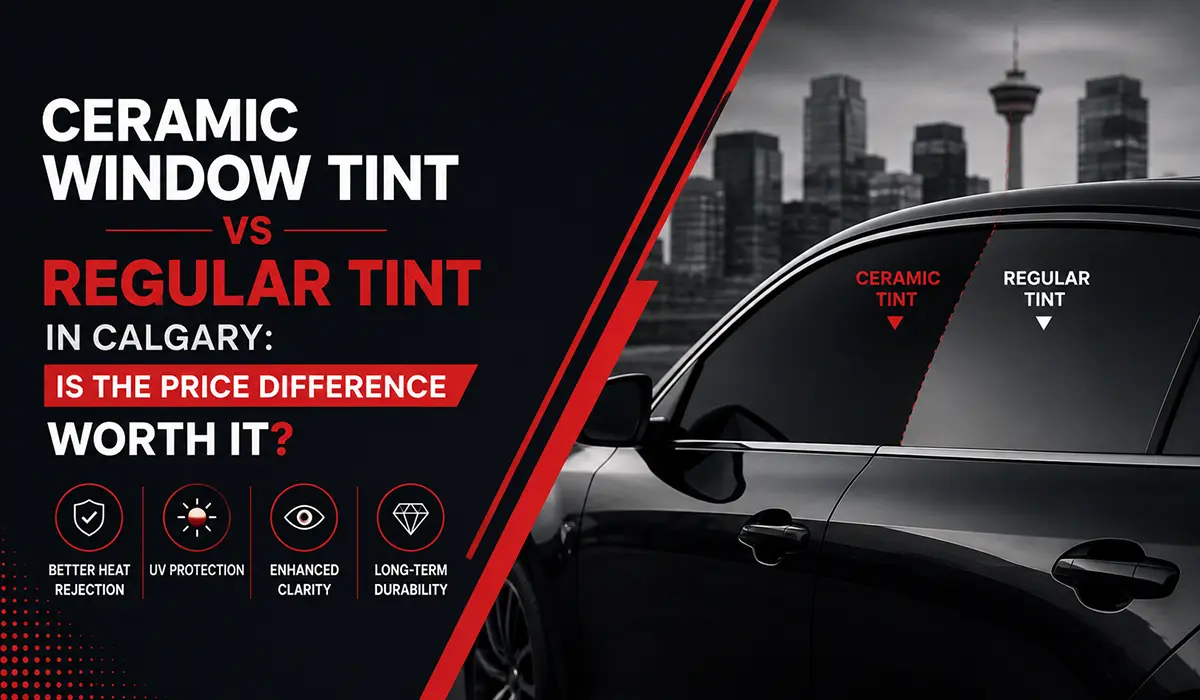
Ceramic window tint costs more than regular dyed film. That much is not a secret. What most Calgary drivers want to know is whether the extra cost is justified for the way they actually use their vehicle, and whether the performance difference is real or mostly a sales pitch.
The honest answer is that ceramic tint and regular dyed film are not the same product with the same outcome at different price points. They work through different technologies, they produce different results in Calgary’s specific climate, and they degrade at very different rates over time. Whether the premium is worth it for you depends on what you are trying to achieve and how long you plan to keep the vehicle.
This guide explains exactly what ceramic tint is, how it differs from regular dyed and carbon films, what each type actually delivers under Calgary conditions, and what you should expect to pay. By the end, you will have the information you need to make a decision that fits your vehicle and your budget.
What Window Tint Film Actually Is
Window tint film is a thin polyester-based laminate applied to the interior surface of your vehicle’s glass. All tint films share the same basic structure: a scratch-resistant topcoat, one or more functional layers that provide the tint’s performance properties, a polyester base layer, and a pressure-sensitive adhesive that bonds the film to the glass.
What separates film types from each other is what goes into the functional layers. That is where dyed film, carbon film, and ceramic film diverge completely, and it is the source of all the meaningful performance differences between them.
Dyed window film
Dyed film is the entry-level product. The functional layer is a dye applied to the polyester base during manufacturing. The dye absorbs incoming light, which produces the dark appearance and reduces visible light transmission. It provides some glare reduction and a moderate degree of UV blocking, but it does very little to reject the infrared heat that makes car cabins uncomfortable on warm days.
The dye is also the film’s weakness. UV exposure breaks it down over time, causing dyed film to fade from its original dark colour toward a purple or brown tint. This fading can begin within two to three years in Calgary’s high-altitude UV environment. Once a dyed film starts to purple, the only solution is removal and replacement.
Carbon window film
Carbon film sits between dyed and ceramic in performance and price. Instead of organic dye, the functional layer contains carbon particles. Carbon is stable under UV, so it does not fade or change colour the way dyed film does. It also provides better infrared heat rejection than dyed film, though not at the level of true ceramic film.
Carbon film is a meaningful upgrade over entry-level dyed film for drivers who want durability and better heat performance at a moderate cost. It is not the right choice if you want the maximum heat rejection available, or if signal interference from metallic films is a concern for your vehicle.
Ceramic window film
Ceramic film uses nano-ceramic particles embedded in the functional layer. These particles are non-metallic and non-conductive, which is important for two reasons. First, they reject infrared heat without blocking radio frequency signals, meaning your GPS, Bluetooth, mobile network, and toll transponders all work normally through ceramic film. Second, ceramic particles are chemically stable, so they do not fade, change colour, or degrade under UV exposure the way organic dyes do.
The nano-ceramic particle structure is what allows ceramic film to achieve high infrared heat rejection even at lighter VLT levels. A ceramic film at 70% VLT can reject more heat than a dyed film at 20% VLT. This is the property that makes ceramic film particularly relevant for Calgary, where the legal front window limit means you cannot use darkness as your primary tool for managing heat and UV.
Ceramic Tint vs Dyed Tint: Head-to-Head Comparison
| Feature | Dyed film | Carbon film | Ceramic film | Why it matters in Calgary |
| Heat rejection (IR) | Low (10–30%) | Moderate (40–60%) | High (70–97%) | Direct cabin comfort in summer; Chinook transitions |
| UV blocking | Moderate (up to 99% on some products) | High (up to 99%) | Up to 99% | Interior fading, dashboard cracking, skin protection |
| Signal interference | None (dyed) | Possible (some metallic hybrids) | None | GPS, mobile, Bluetooth, toll transponders |
| Colour stability | Fades to purple/brown within 2–5 yrs | Stable | Stable | Long-term appearance without replacement |
| Legal front VLT options | 70%+ available | 70%+ available | 70%+ available; more heat rejection per VLT unit | Alberta requires no tint on front side windows for most |
| Glare reduction | Moderate | Good | Excellent | Winter driving on bright snow days |
| Warranty | Typically 1–3 yrs | 3–5 yrs | Lifetime (XPEL, 3M) | Long-term confidence in product performance |
| Relative cost | $ | $$ | $$$ | Premium is the question this guide answers |
Why Ceramic Film Performs Differently in Calgary Specifically
Window tint performs differently in Calgary than it does in a mild-weather city, and understanding why helps explain why the ceramic premium is easier to justify here than it might be elsewhere.
Calgary summers are hotter inside your car than the temperature outside suggests
Calgary sits at just over 1,000 metres above sea level. At that elevation, UV intensity is measurably higher than at sea level, and solar heat load inside a parked or moving vehicle builds faster than in lower-altitude cities. On a 28C Calgary afternoon, interior cabin temperatures can reach 60C or higher in direct sun. Dyed film absorbs some visible light, which reduces glare, but it does little to block the infrared radiation that is responsible for the majority of that heat buildup. Ceramic film rejects the infrared spectrum directly, which translates to a cabin that is meaningfully cooler on the same afternoon with the same legal tint level.
Alberta’s legal front window limits make heat rejection per VLT unit critical
Alberta does not permit aftermarket tint on front side windows for most drivers. This means the only way to get solar protection on the windows you spend the most time looking through is to use a film that delivers performance at a high VLT level. A 70% VLT ceramic film from XPEL or 3M can reject up to 60% of solar heat energy and block 99% of UV while appearing nearly clear. A 70% VLT dyed film at the same visual darkness delivers a fraction of that thermal performance. For Calgary drivers who cannot legally go darker on their front windows, ceramic film is not a luxury. It is the only way to get meaningful heat and UV rejection where it counts.
CHD17 installs XPEL Prime XR and 3M Ceramic IR films, both of which are designed to deliver maximum heat and UV performance within Alberta’s legal tint requirements. We always install to legal limits. Front window tint violations in Alberta carry fines of up to $224 per window.
UV protection matters in winter too
UV damage does not take winter off. On a clear January day in Calgary, UV index levels are lower than midsummer but not zero, and the sun sits at a lower angle that can hit the dashboard, seats, and occupants at a more direct angle than summer sun coming through the roof. Leather dashboards crack, vinyl fades, and seat surfaces degrade under sustained UV exposure regardless of the season. Ceramic tint blocks up to 99% of UV year-round, including through Calgary winters, which adds up to meaningful interior preservation over the lifespan of a vehicle.
Cold-weather performance and adhesion
One of the less-discussed differences between film types is how they behave in cold weather. Dyed film adhesives can become brittle in extreme cold, which contributes to lifting at the edges, bubbling, and delamination over time when exposed to Calgary’s sustained sub-zero temperatures. Quality ceramic films use adhesive systems engineered to remain stable through Alberta winters, which is part of why the manufacturer warranty periods on ceramic film are significantly longer than on entry-level dyed products.
Alberta Window Tint Laws: What You Need to Know Before You Buy
Before spending any money on window tint, it is worth understanding exactly what Alberta’s regulations allow. Choosing a film that is illegal for your application means paying for removal in addition to a fine, which makes the initial price comparison irrelevant.
| Window | Legal status | Darkness permitted | Notes |
| Windshield | No aftermarket tint | Factory glazing only | Visor strip at top is permitted |
| Front driver window | No aftermarket tint | 100% VLT only | Fine up to $224; medical exemptions exist (see Alberta.ca) |
| Front passenger window | No aftermarket tint | 100% VLT only | Same as driver window |
| Rear side windows | Permitted | Any darkness | Both side mirrors required if rear is tinted |
| Rear window | Permitted | Any darkness | Both side mirrors required |
The practical implication for most Calgary drivers is that film choice on the front windows is about UV and heat rejection technology, not darkness. You cannot make front windows darker than factory glass by law. What you can do is apply a nearly-clear ceramic film that performs significantly better than the uncoated factory glass at blocking UV and infrared heat. That is a legitimate, legal upgrade that ceramic film is uniquely positioned to deliver.
On rear windows, you have full latitude to choose any darkness level. This is where the combination of ceramic technology with your preferred VLT level gives you privacy, comfort, and maximum performance simultaneously.
Signal Interference: Why Non-Metallic Ceramic Film Matters for Modern Vehicles
Older metallic window films, which are still sold in some shops as a budget option, use a metallic layer for heat rejection. That metal layer also acts as a partial Faraday cage around your vehicle, which degrades or blocks radio frequency signals including GPS navigation, Bluetooth connectivity, keyless entry, mobile data, and toll transponders.
For a vehicle from five or ten years ago, this was sometimes an acceptable trade-off. For modern vehicles, most of which rely on constant connectivity for navigation, driver assistance features, phone integration, and in-vehicle wireless systems, a metallic film that disrupts those signals is a real problem.
Ceramic film is non-metallic and non-conductive. It rejects heat through the ceramic particle structure rather than through metal interference. Every signal that reaches your vehicle through the factory glass continues to reach it through ceramic film. Your GPS works. Your Bluetooth works. Your remote start works. Your toll transponder works.
Vehicles with embedded antenna systems in the glass, including most Teslas and many newer European vehicles, are particularly sensitive to metallic film interference. If you drive any of these vehicles, ceramic film is not just the performance choice. It is the only technically appropriate choice.
What to Expect to Pay: Ceramic Tint vs Regular Tint in Calgary
Window tint pricing in Calgary varies based on film type, vehicle size, and installation quality. The figures below reflect current market ranges at a professional-grade installation shop. Budget installers operating with lower-quality film and less experienced technicians will advertise lower prices, but the comparison is not equivalent in outcome.
| Film type | Sedan/coupe | SUV/truck | What drives the cost |
| Dyed film | $150–$280 | $200–$350 | Low material cost; basic adhesive; short warranty |
| Carbon film | $250–$400 | $320–$500 | Stable pigment; better heat rejection; mid-range warranty |
| Ceramic film (XPEL, 3M) | $400–$700 | $500–$900 | Nano-ceramic particles; lifetime warranty; highest performance |
How to think about the price gap
The typical ceramic premium over dyed film runs $200 to $400 for most vehicles. Evaluated as a one-time decision, that gap looks significant. Evaluated across the lifespan of the film, it looks different.
A dyed film that fades and requires replacement in three years costs you the original installation plus another full installation. Two dyed installs over six years typically exceeds the cost of a single ceramic install. Add in the performance difference during those six years and the value comparison shifts further toward ceramic.
The more meaningful calculation, though, is what each film actually delivers for how you use your vehicle. If you drive primarily at night, park in a covered structure, and live in a moderate climate, the ceramic premium is harder to justify. If you commute on Calgary roads in direct sun, care about interior preservation, drive a vehicle with embedded antenna systems, or want a film that performs at legal tint levels, the ceramic premium is not a luxury. It is the cost of getting what you actually came for.
XPEL and 3M Ceramic Films: What CHD17 Installs and Why
Not all ceramic films are the same. The nano-ceramic particle technology is a manufacturing process, and the quality of the particles, their density, and how they are integrated into the film structure varies significantly between brands.
CHD17 Customs installs XPEL Prime XR and XPEL Prime XR Plus, along with 3M Ceramic IR, for clients who choose ceramic film. These are the same films that independent automotive detailing communities consistently recommend based on long-term performance testing.
XPEL Prime XR
- IR heat rejection: up to 88%
- UV blocking: 99.9%
- Available VLT levels: 5%, 15%, 25%, 35%, 40%, 50%, 70%, and clear
- Warranty: Lifetime (non-transferable)
- Signal interference: None (non-metallic ceramic particles)
XPEL Prime XR Plus
The XR Plus is XPEL’s premium ceramic offering, using a multi-layer nano-ceramic structure that achieves higher infrared rejection and improved colour stability versus the standard XR. It is the right choice for vehicles where maximum performance is the priority.
- IR heat rejection: up to 98%
- UV blocking: 99.9%
- Warranty: Lifetime (non-transferable)
3M Ceramic IR
3M Ceramic IR uses 3M’s proprietary nano-ceramic technology and is another industry benchmark product. For drivers who prefer a 3M product or who are working within a specific vehicle warranty context that calls for a 3M-authorised installation, it is a fully equivalent alternative to the XPEL XR series.
The film brand you choose matters less than the installation quality. A premium film installed by an inexperienced technician will develop lifting, bubbling, and edge separation faster than a properly installed mid-range product. CHD17’s installers are trained on the specific handling requirements of each film we carry.
Why Installation Quality Matters as Much as Film Quality
A ceramic film installation involves more than applying film to glass. The preparation process, the technique used to lay the film, how edges are handled, and how the film is trimmed all determine whether the end result looks factory-clean or shows visible lines, trapped debris, lifting corners, or bubbles within the first year.
Common signs of a poor installation include:
- Visible horizontal or vertical cut lines where film sheets meet
- Small bubbles or debris trapped under the film surface
- Lifting or gapping at the corners or along rubber seals
- Inconsistent darkness across a single pane
- Film extending past the glass edge onto the rubber or trim
At CHD17, every installation begins with a controlled-environment film cleaning of the glass to remove dust, oil, and debris before the film is laid. We use a dust and particle suppression approach during application that eliminates the contamination problem that produces visible specks under the film. Edges are handled with a micro-trimming technique that keeps film seated cleanly against the rubber seal without visible cutlines.
The installation environment matters too. Tint applied in a dusty shop, a parking lot, or in cold conditions that prevent adhesive curing will never look as clean as tint applied in a heated, filtered-air workspace. Our Calgary shop is climate-controlled for tint work year-round.
Who Should Choose Ceramic Tint and Who Can Use Regular Film
Ceramic tint is the right choice if:
- You commute daily in Calgary sun and want real heat rejection on front windows at legal tint levels
- You drive a vehicle with embedded antenna systems (Tesla, BMW, Mercedes, Audi, Rivian, modern trucks)
- You want a film that will not fade, purple, or require replacement within three to five years
- You care about interior preservation and UV protection year-round
- You are tinting a new or high-value vehicle and want the installation to last its lifespan
- You want a lifetime warranty backed by XPEL or 3M directly
Carbon or dyed film may be sufficient if:
- You drive primarily at night or in low-sun conditions
- You park primarily in a covered parkade and the vehicle sees limited direct sun
- You are tinting a lease vehicle you plan to return within two years
- Budget is the primary constraint and you understand you may need replacement sooner
- You are tinting rear windows only and want maximum darkness at the lowest cost
One configuration that works well for many Calgary drivers is a hybrid approach: ceramic film on the front windshield and front windows (where UV and heat rejection per VLT unit matter most and where you cannot go dark anyway) and carbon or ceramic on the rear windows depending on the desired privacy level and budget. This approach applies the premium where it delivers the most value.
Frequently Asked Questions
Does ceramic tint look different from regular tint?
At the same VLT level, ceramic tint does not look substantially different from the outside than dyed or carbon film. The visual darkness you see is determined by VLT, not by film type. The difference is in what the film does: ceramic film at 35% VLT rejects dramatically more heat and blocks more UV than dyed film at 35% VLT, even though both appear the same shade of dark from the exterior.
Can I tint my front windows legally in Calgary?
Alberta prohibits aftermarket tint on front side windows for most drivers. There is a medical exemption process through Alberta.ca for conditions including melanoma and certain skin cancers, which allows clear UV-blocking film with at least 50% VLT. For the vast majority of Calgary drivers, front windows must remain at factory glass VLT (100% or close to it). You can apply a nearly clear ceramic film to front windows to add UV and heat rejection without adding visible darkness. Rear side windows and the rear window can be tinted to any darkness level.
Will ceramic tint interfere with my Tesla’s systems?
No. Ceramic film is non-metallic and non-conductive. It will not interfere with Tesla’s Autopilot cameras, Bluetooth, mobile data connection, keyless entry, or any other wireless system. Metallic films can cause issues on Teslas and other vehicles with glass-embedded antenna systems. Ceramic film is specifically the solution to that problem.
How long does ceramic tint last?
XPEL and 3M ceramic films carry lifetime warranties against bubbling, peeling, colour change, and adhesion failure. In practice, quality ceramic film installed properly in a professional environment can last the full lifespan of a vehicle without requiring replacement. Dyed film typically requires replacement within two to five years in Calgary’s UV environment.
How long does tint installation take at CHD17?
A full vehicle tint typically takes two to four hours depending on the number of windows, the vehicle’s window configuration, and the complexity of any curved or compound glass. We recommend dropping the vehicle off rather than waiting, to allow the installation environment to be properly prepared and to give us time to handle any glass-specific complications without rushing the result.
What is the window tint price at CHD17 Customs in Calgary?
Pricing depends on your vehicle size and the film product you choose. For a current quote specific to your vehicle, call or text us at +1 (403) 478-2217 or submit a request through our contact page. We offer free quotes and can walk you through which film makes sense for your situation.