

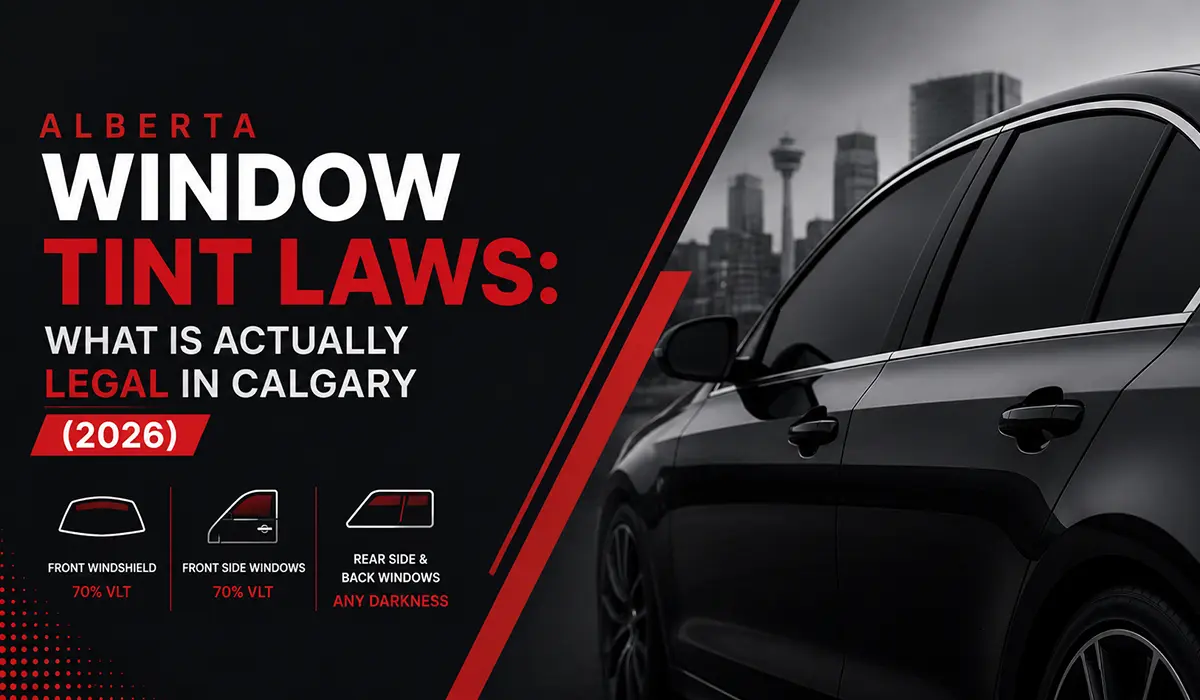
If you have spent twenty minutes searching this, you have probably noticed something strange. One Calgary shop says the legal limit on your front windows is 50 percent VLT. Another says 70 percent. A third says any aftermarket tint on the front is banned outright. A fourth says Alberta never wrote a number down at all.
They cannot all be right, and the confusion costs drivers real money. We see cars come into our Calgary shop every month with tint that has to come off, usually because someone trusted a cheap installer who repeated whatever they read online.
Here is a straight answer, including the parts that are genuinely unclear.
Why Nobody Can Agree on Alberta’s Tint Law
Most provinces write a number into their legislation. British Columbia does. Ontario has a clearer position. Alberta took a different approach.
Alberta’s rules live in the Traffic Safety Act and the Vehicle Equipment Regulation. Rather than setting a specific visible light transmission percentage for your windows, the province uses language about adequate visibility and about materials applied to the windshield and front side windows that obstruct the driver’s view.
That is the root of the confusion. Shops that quote you 70 percent are borrowing the federal Motor Vehicle Safety Standard that governs how glass leaves the factory, which is a manufacturing standard, not a rule about what you can add afterward. Shops that quote 50 percent are usually borrowing from another province entirely.
So the honest position is this. Alberta’s regulation restricts what you can apply to your windshield and front side windows on the grounds of visibility, and it does not publish a friendly percentage you can point at. Enforcement fills the gap.
What This Means in Practice
For the front windshield, only a narrow strip along the top is realistically accepted, and clear or near clear UV film is the safest product if you want protection without a visual change.
For front side windows, aftermarket film is the risky zone. Dark film on the driver and passenger windows draws attention, and officers have discretion. Very light ceramic film is the conservative choice.
For rear side windows and the rear windshield, Alberta is relaxed. Drivers routinely run 20 percent, 15 percent and even 5 percent limo tint on the back with no issue, provided the vehicle has working exterior mirrors on both sides. Nearly every vehicle built in the last thirty years does.
Reflective and mirrored film is a separate problem. It causes glare for other drivers and is treated far less kindly than a non reflective film of the same darkness.
What Actually Gets You Pulled Over in Calgary
Enforcement in Alberta leans on officer judgment more than on instruments. Some agencies carry calibrated tint meters. Many do not, and the assessment is visual.
From what we see coming through the shop, these are the situations that generate tickets:
Very dark film on the front driver and passenger windows, particularly at night, when an officer cannot see into the cabin during a stop. This is the single most common trigger.
Mirrored or reflective film on any window.
Tint that is bubbling, purple or peeling. Failed film distorts vision and it looks like neglect, which invites a closer look at the rest of the vehicle.
Front windshield film below the visor strip.
A ticket typically runs in the low hundreds of dollars. The bigger cost is usually the removal and reinstallation, which can run more than the original job because old adhesive on defroster lines has to come off without damaging them.
Factory Glass Is Not the Same as Aftermarket Film
This trips up a lot of people. Your SUV came with dark rear windows from the dealership and nobody ever ticketed you for it, so surely you can match the front.
Factory privacy glass is tinted during manufacturing. The colour is in the glass itself and it is engineered to meet federal safety standards. Aftermarket film is a layer added on top of glass that already blocks some light. Factory glass usually sits somewhere around 70 to 74 percent VLT on the front, so adding any film at all pushes the total measurement below where it started.
That is why an installer measuring your car will read a lower number than the film’s rating suggests. Film rated at 70 percent applied to glass at 72 percent gives you a combined reading closer to 50 percent.
Any shop that does not explain this to you is either not measuring or not telling you.
The Part Most Drivers Get Wrong: Dark Does Not Mean Cool
Here is the thing that makes the legal limits far less painful than they sound.
Darkness and heat rejection are two different properties. People assume a 5 percent limo tint must block more heat than a light film, because it looks like it should. That was true in the 1990s when most film was dyed.
Modern ceramic film works differently. The ceramic particles in the film reject infrared radiation, which is what you feel as heat, without needing to be dark. A quality ceramic film at a light shade can reject a large share of solar heat and block essentially all UV, while staying visually subtle enough to keep you out of trouble.
For Calgary specifically this matters more than people expect. We sit at over a thousand metres of elevation with a lot of clear sky days, and the UV load here is genuinely high. Interior fade, cracked dashboards and faded leather are common on vehicles that have spent five Calgary summers parked outside.
The Setup We Recommend Most Often
The combination that keeps almost everyone happy looks like this.
Clear or near clear ceramic film on the windshield, which gives you UV and heat rejection with no visual change and no legal exposure.
Light ceramic film on the front side windows, chosen conservatively.
Darker ceramic film on the rear sides and rear glass, wherever you want it for privacy and for keeping rear passengers comfortable.
You end up with real heat performance across every piece of glass and a car that does not attract a second look.
Medical Exemptions
Alberta does allow for medical considerations in cases involving conditions like lupus, photosensitivity disorders, or certain post surgical situations. The process involves documentation from a physician, and it is handled through Alberta Transportation rather than through your installer.
If you think you qualify, sort the paperwork out before the film goes on, not after you have been stopped. We are happy to talk through what shade would suit your situation, but we cannot issue the exemption.
If You Drive Between Provinces
This catches people constantly, and it is worth knowing if you travel.
British Columbia restricts tint on all windows including the rear, so the dark back glass that nobody bothers you about in Calgary can become a problem the moment you cross into BC.
Saskatchewan is stricter still. SGI prohibits aftermarket tint on the windshield and front side windows entirely, and that prohibition includes clear film. If you split your time between Calgary and Regina, that difference is worth understanding before you commit.
We run shops in both cities, so we deal with this more than most. If you drive both provinces regularly, tell us and we will spec the car for the stricter of the two.
How We Handle Tint at CHD17 Customs
Every tint job that leaves our Calgary shop gets measured. Not eyeballed, measured, so you know what is actually on your glass rather than what the box claimed.
We will tell you honestly if what you are asking for is going to cause you problems, even when that is not what you want to hear. Talking a customer out of a shade they came in asking for is a worse day for us commercially and a much better outcome for them.
We only install film we are willing to warranty, and we will not put film on a windshield below the visor line.
Not sure what shade is right for your vehicle?
Bring it by our shop at 3640 26 St NE in Calgary and we will show you the difference between shades on real glass, measure your factory VLT, and give you a quote with no pressure. Request an appointment or call us.
FAQs
Is window tint legal in Alberta?
Yes. Rear side windows and rear glass have essentially no practical restriction in Alberta. The restrictions apply to the windshield and the front side windows, where the regulation is concerned with obstruction of the driver’s view. A conservative light ceramic film on the front is the safe approach.
What is the legal tint percentage in Alberta?
Alberta’s regulation does not publish a specific VLT percentage the way many provinces do. It uses visibility based language instead, which is why so many online guides quote different numbers. Enforcement is largely based on officer judgment, and very dark front film is what draws attention.
How much is a tint ticket in Alberta?
Fines generally fall in the low hundreds of dollars. The larger expense is usually removal and replacement of the film, which can exceed the cost of the original installation because adhesive has to be cleared from rear defroster lines without damaging them.
Can I tint my front windshield in Alberta?
Only a strip along the top of the windshield is realistically accepted. Full windshield film below that band is not. Clear UV blocking film is a safer option if your goal is heat and UV protection rather than a darker look.
Does legal tint still block heat?
Yes, if it is ceramic film. Heat rejection comes from infrared blocking ceramic particles, not from darkness. A light ceramic film can reject a large share of solar heat and block essentially all UV while staying visually subtle.
Is factory tinted glass legal in Alberta?
Yes. Factory privacy glass is manufactured to federal safety standards and is not aftermarket film. Note that factory front glass already sits around 70 to 74 percent VLT, so any film added on top lowers the combined measurement.
Do tint laws differ in Saskatchewan?
Significantly. SGI prohibits aftermarket tint on the windshield and front side windows entirely, including clear film. Only the top 75mm of the windshield may be tinted. If you drive both provinces, spec your vehicle for the stricter rule.